Understanding Rugby’s Rules: A Beginner’s Guide to the Game
Welcome to the exhilarating world of rugby! As a passionate player, David Delavari, I know that the fast-paced action and strategic depth of the game can be captivating. However, for those new to the sport, understanding the fundamental rules is the first step to truly appreciating its beauty. Fear not! This beginner’s guide will break down the essential rules of rugby, making you feel like part of the scrum in no time.
The Basics: Objective and Players
At its heart, rugby is a team sport played between two teams of 15 players (in Rugby Union, the most common form). The objective is simple: to score more points than the opposition. Points can be scored in several ways, which we’ll get to shortly. The game is played on a rectangular field with H-shaped goalposts at each end.
Moving the Ball: Passing and Running
- Running: Players can run with the ball in hand. This is a primary way to gain ground and advance towards the opposition’s try line.
- Passing: The crucial rule here is that the ball can only be passed laterally (sideways) or backwards. Forward passes result in a penalty to the opposing team. This unique rule emphasizes teamwork and creating space through running and support play.
- Kicking: Players can kick the ball forward to gain territory, put pressure on the opposition, or attempt to score points.
Scoring Points: The Ways to Win
There are four main ways to score points in rugby:
- Try (5 points): This is the most common way to score. A try is awarded when a player grounds the ball in the opposition’s in-goal area (the area beyond the goal line).
- Conversion (2 additional points): After a try, the scoring team gets an opportunity to kick the ball between the uprights and over the crossbar of the goalposts. The kick is taken from a line parallel to where the try was scored.
- Penalty Goal (3 points): If the opposition commits a significant penalty, the non-offending team can choose to attempt a place-kick at goal.
- Drop Goal (3 points): During open play, a player can attempt to kick the ball through the uprights and over the crossbar after dropping it onto the ground and kicking it as it bounces.
Tackling: Stopping the Advance
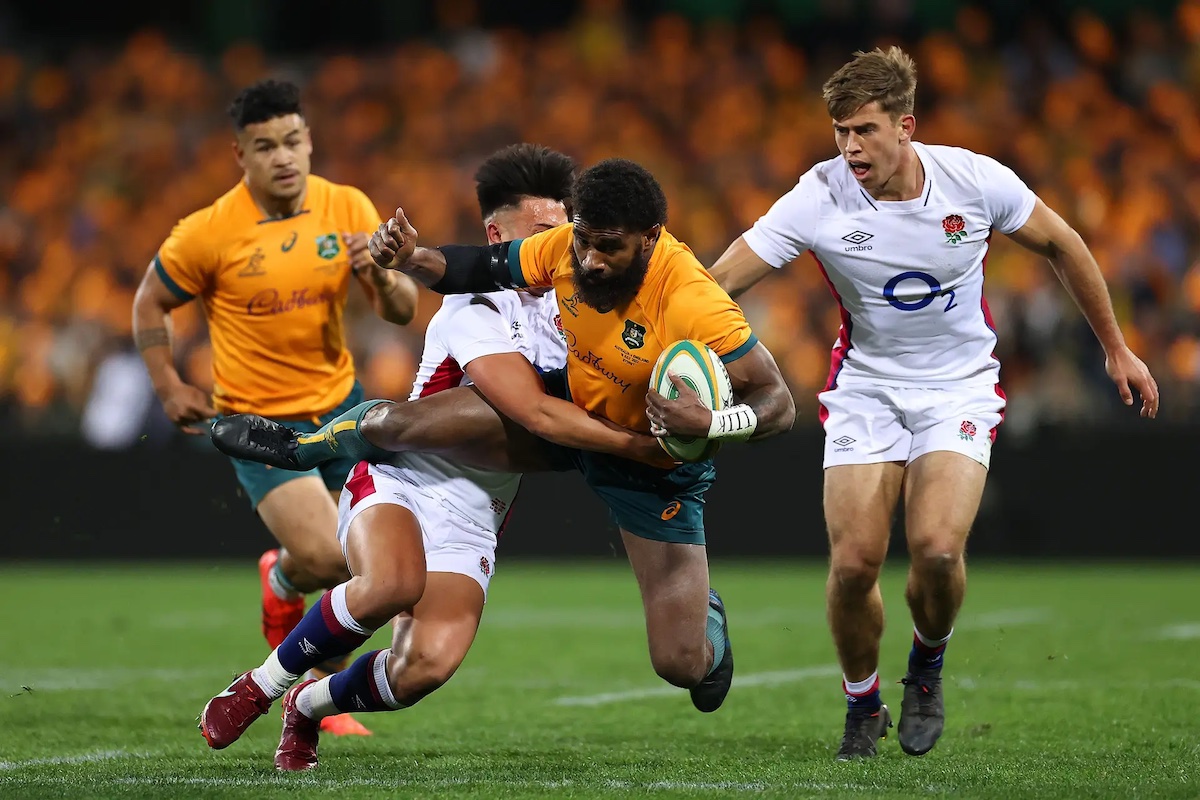
Tackling is a fundamental part of rugby defense. A tackle occurs when a player brings the ball carrier to the ground. Key rules regarding tackling include:
- Only the ball carrier can be tackled.
- Tackles must be made below the shoulder line. High tackles are dangerous and result in penalties.
- Once a tackle is made, the tackled player must immediately release the ball. They cannot hold onto it to prevent the opposition from contesting possession.
- Tackled players must also move away from the ball immediately, allowing other players to compete for it.
The Breakdown: Contesting Possession
After a tackle, the contest for possession of the ball takes place in an area called the breakdown. There are two main types of breakdowns:
- Ruck: A ruck forms when at least one player from each team are in contact, on their feet, and over the ball that is on the ground after a tackle. Players in a ruck must try to step over the ball and cannot use their hands to pick it up.
- Maul: A maul occurs when at least three players – the ball carrier and at least one player from each team – are in contact and on their feet around the ball. The ball carrier is typically held upright. Players in a maul try to drive forward to gain ground.
Set Pieces: Restarting Play
When play stops due to certain infringements or after the ball goes out of play, the game restarts with set pieces:
- Scrum: A scrum is a way to restart play after minor infringements or when the ball becomes unplayable in a ruck or maul. It involves eight forwards from each team binding together in a specific formation and pushing against each other to win possession of the ball, which is put into the tunnel between them by the non-offending team’s scrum-half.
- Lineout: A lineout restarts play after the ball goes out of touch (sidelines). The forwards of each team line up perpendicularly to the touchline, and the ball is thrown back into play between them. Players can jump to compete for the ball, often with the assistance of lifters.
Infringements and Penalties
Like any sport, rugby has rules and infringements. Minor infringements can result in a free kick, where the non-offending team can kick the ball but cannot score directly with a kick at goal. More serious infringements result in a penalty kick, where the non-offending team can choose to kick at goal for three points, kick the ball downfield to gain territory, or take a quick tap and run. Repeated or dangerous infringements can lead to yellow cards (temporary suspension of a player for 10 minutes) or red cards (permanent expulsion from the game).
Key Terms to Get You Started
- Try Line: The goal line that a player must cross and ground the ball on to score a try.
- In-Goal Area: The area beyond the try line where the ball must be grounded for a try.
- Forward Pass: An illegal pass thrown towards the opposition’s goal line.
- Knock-On: When a player drops the ball forward. This results in a scrum to the opposition.
- Offside: A player is offside if they are in front of the ball when it is last played by a teammate and not behind the hindmost foot of a ruck, maul, or scrum.
The Spirit of Rugby
Beyond the rules, rugby is also known for its strong ethos of sportsmanship, respect for the referee, and camaraderie. While it’s a physically demanding sport, the values of teamwork, discipline, and fair play are deeply ingrained in the game.
This is just a starting point, but understanding these basic rules will significantly enhance your enjoyment of rugby. As you watch more games, you’ll naturally pick up the nuances and complexities that make this sport so captivating. Welcome to the RugbyMania – we’re glad to have you!
Latest Articles







Latest Updates in Online Courses and Education.
Stepping onto the rugby pitch requires more than just passion and skill; having the right gear is paramount for safety,...
Read MoreThe roar of the crowd, the thunder of the tackles, the exhilaration of the try – these are sensations that...
Read MoreThe Six Nations Championship. Just the name conjures images of fierce rivalries, passionate crowds, and breathtaking rugby played at its...
Read MoreTo excel on the rugby pitch, you need a potent combination of speed, strength, and stamina. Whether you're aiming to...
Read MoreRugby is a sport brimming with passion, drama, and moments that transcend the game itself. From heroic individual feats to...
Read MoreThe scrum. For the uninitiated, it might look like a chaotic mass of bodies. But for those of us who’ve...
Read MoreThe Rugby World Cup stands as the pinnacle of international rugby, a quadrennial celebration of skill, strength, and national pride....
Read MoreRugby is a sport rich in history and graced by incredible athletes who have not only excelled on the field...
Read MoreExploring the Ancient World: Bible History & Archaeology
Uncover the people, places, and events that shaped biblical and ancient history.
Dive into a rich collection of resources on ancient civilizations, biblical archaeology, and historical contexts. From the empires of Babylon and Assyria to the life of Jesus and the early church, discover maps, timelines, commentaries, and scholarly insights that bring the ancient world to life. Explore the intersection of faith, history, and archaeology with our curated articles, maps, and studies.